Showing posts with label American. Show all posts

Wednesday, May 21, 2014

GODZILLA 2014 (Review)

Godzilla (2014)

Director: Gareth Edwards

RATING: 3.5 / 5

After a 10-year absence, the King of the Monsters has returned -- with a vengeance! 

After its first week of release, Gareth Edwards's monstrous re-imagining of Japan's most famous monster is smashing its way through the box office to the tune of a $196 million worldwide opening weekend. Western audiences are obviously coming out in droves to support Godzilla's big-budget return to the big screen, but really how faithful is Edwards's take on Godzilla? And can it hold a nuclear flame to the other installments in the monster's 60-year career?

The short answer is a complicated one. I have never seen a Godzilla movie that I so thoroughly enjoyed while my butt was in the theater that I then so profoundly disagreed with while leaving the theatre. Talk about cognitive dissonance! This review is an attempt to bridge my enthusiasm with my disappointment. I guess I could say that I loved Godzilla the same way I love films like Godzilla vs. Hedorah, Godzilla vs. Gigan, and Godzilla vs. Megalon. They're all really fun and light B-movies, but they do not feature my preferred representation of Godzilla.

 SPOILERS from this point on.

Godzilla travels to the US to try out for the San Francisco Giants.

Saturday, May 10, 2014

GODZILLA (1998): 30 Days of Godzilla

DAY 24
GODZILLA (1998)

On May 16th, 2014, Warner Bros. and Legendary Pictures will release Gareth Edwards's GODZILLA, a big-budget 3D American take on Japan's most famous monster. There's definitely a lot of fan excitement and goodwill surrounding this new Godzilla film, which his first in 10 years. However, this is not the first time that America has taken a stab at the King of the Monsters. To this day, fans are still haunted by the memory of America's first attempt: Roland Emmerich's critically-panned and fan-reviled action crapfest GODZILLA 1998.


Saturday, May 3, 2014

THE RETURN OF GODZILLA (1984): 30 Days of Godzilla

DAY 17


THE RETURN OF GODZILLA  (1984)

aka. Godzilla
aka. Godzilla 1985

The legend is reborn. 

After a nine-year hibernation, Godzilla returns to the big screen in both Japan and America for a much-hyped reboot of the Godzilla franchise. Presented as a direct sequel to the original Gojira (disregarding every other Godzilla film after 1954), The Return of Godzilla aimed to take the King of the Monsters back to his dark anti-nuclear origins. The Return of Godzilla may not have been the international box office smash Toho was hoping for, but it did well enough to launch a brilliant series of Japanese films in the 90s that have yet to be rivaled. More importantly, it made Godzilla scary again.


Sunday, April 20, 2014

KING KONG vs. GODZILLA (1962): 30 Days of Godzilla

DAY FOUR

KING KONG vs. GODZILLA (1962)

Ladies and gentlemen, step right up to witness a cataclysmic, catastrophic clash of titanic terrors! Get y'er front-row seats to the knock-down, drag-out battle of the century! Tonight Japan's reigning monster supreme Godzilla goes toe-to-toe with the American ape of astonishing strength: King Kong! When the dust finally settles on the ruins of Japan, who will emerge the new King of the Monsters?


Friday, April 18, 2014

GODZILLA: KING OF THE MONSTERS (1956): 30 Days of Godzilla

DAY TWO

GODZILLA: KING OF 
THE MONSTERS (1956)

Although Gojira had already debuted in Japan two years prior, Americans would only come to know him in 1956 when Gojira was re-edited and released in North America as Godzilla: King of the Monsters!


Wednesday, October 16, 2013

PACIFIC RIM (Review)

Pacific Rim (2013)

Director: Guillermo del Toro

RATING: 4 / 5

I broke up with blockbusters this summer. Then a 300ft robot beat the unholy crap out of a giant sea monster, and everything was right with the world. Now I can relive the excitement all over again with Pacific Rim on DVD and Blu-ray

This past summer movie season was bloated with big budget blockbuster hopefuls, many of which flopped financially and critically. Although it didn't perform as well as I expect the studio expected, Pacific Rim rose from the depths of the summer movie doldrums and punched a hole right through the lazy ranks of the competition with its gleefully geeky premise and heavy manga / tokusatsu influence. It's big. It's over the top. It's unapologetic in its nerdiness and un-ironic fun. Pacific Rim is what summer movies should be about! It should be no surprise coming from a blog dedicated to creature features and Japanese giant monster movies that Pacific Rim was favorite movie of the summer. It's by no means a perfect movie, but it stands in stark contrast to what's endemically wrong with the vast majority of summer blockbusters.

Puny Humans
Heavily inspired by Asian manga and Japanese Godzilla films, Pacific Rim takes us into a future where humanity is under repeated attack by 300 ft toxic creatures called kaiju (Japanese for "monster" or "strange creature") that emerge from an inter-dimensional portal at the bottom of the Pacific Ocean. After conventional weapons fail to repel the first devastating kaiju attacks that lay waste to San Francisco, Manila, Cabo, and Sydney, humanity falls helpless before the rampaging beasts. In response to the monster menace, the earth's scientists create a last line of defense: the Jaegers. Developed by an international monster defense program, the Jaegers are kaiju-sized humanoid robots controlled by two or three pilots in a neural interface, becoming one -- in body and mind -- with the machine.
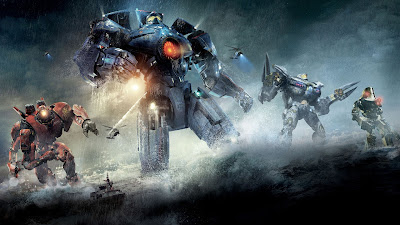
Transformers: Eat Your Metal Hearts Out
The Jaegers prove incredibly successful at first, but soon the kaiju attacks become so frequent and unexpectedly powerful that Jaegers begin to fall at an alarming rate. As humanity prepares to decommission the Jaeger program in favour of a giant defensive wall along the pacific rim, Raleigh Becket (Charlie Hunnam), a famous Jaeger pilot with a tragic past, is brought out of retirement by his old commander (played by the always impressive Idris Elba) and put back in control of his former Jaeger: Gipsy Danger. Together with his new rookie partner Mako Mori (Rinko Kikuchi), Raleigh must put aside the traumatic death of his co-pilot, overcome new rivalries, and find the courage to make one final assault against the apocalyptic alien menace that threatens to wipe out all of humanity from the very depths of the ocean.

This is what the Earth gets for releasing Godzilla 1998
Pacific Rim is beautifully textured and exists in its own wonderful aesthetic universe. An old-world industrial gothicnness meets a saturated neon future in Pacific Rim, which boasts exciting robot/monster battles that punctuate a solid sci-fi story that's driven, at its core, by the human element. International stars Idris Elba, Charlie Hunnam, and Rinko Kikuchi bring much needed gravitas, heroism, and tough-as-nails tenderness to humanize this monster mashing movie. While Pacific Rim lacks the practical charm of man-in-suit monster movies with hand-made miniature sets and often looks instead like one big videogame, Pacific Rim's real charm lies in the rich and textured world del Toro creates around the monster mayhem. From the smallest CGI details to the broadest comic book-inspired themes, Pacific Rim feels like it takes place in an implausibly plausible world, and it's a feast for the senses.

Gipsy Danger's got swag
Given del Toro's track record for thoughtful, artful films like Pan's Labyrinth, Pacific Rim got some flack for being just another typical summer movie. As a kid, I never understood why "summer movie" was a term lobbed by critics as an insult. In my eyes, summer movies were fun! Shit blew up, heroes solved global problems with their fists, and there was no shortage of cool monsters and aliens. What more could a pre-teen kid want? Then I got older. Older than I wanted to admit to myself, in fact, and began to see why all these adult movie fans around me were taking pot shots at what I considered to be harmless fun. As one gets older and consumes more and more media, the spectacle of the summer movie becomes more and more tedious, especially if there's no story or heart to back it up. One of the reasons I started All Monsters Blog is that I've been gravitating back toward re-discovering retro sci-fi flicks and Japanese man-in-suit monster movies as a response to the numbing coldness I feel in so much modern mainstream sci-fi. Sure, the Godzilla and Gamera movies of yesteryear are just as silly and dumb if not more so than most mainstream blockbusters, but they come from an era of B movies that were spared the blight of product placement, gratuitous CGI spectacle, and budget-inflating celebrity fixation that now infest most summer movie fare. Somewhat naively, I've been holding out hope in my adulthood that there's still something entertaining to be gained from the brainless summer epics like Michael Bay's Transformers series or the routine disaster films Roland Emmerich sheds like dead skin cells. Unfortunately, I can't even like these films ironically anymore. They are just completely offensive garbage.
The Right Stuff
But my hope for the summer movie didn't really die until this year when I walked out of Zach Snyder's Man of Steel completely heartbroken. Having just watched the most important comic book hero ever created turned into a grim, joyless, two-hour parade of senseless destruction and product placement, I couldn't find anything heroic or fun about a guy in a cape snapping necks and smashing through 7-11's, Marlboro trucks, Coca-Cola signs, and even a damn IHOP. Man of Steel drained everything wholesome and fun out of the Superman character in a cynically calculated attempt to manufacture summer spectacle for maximum general audience profit. Summer movies have become "popcorn movies" that are as repulsive as their namesake. They're bland, stale, and barely edible wads of overcooked husk that studios hope we'll mindlessly cram down our gluttonous throats if they're coated with enough salt and fat. Make no mistake: Pacific Rim is no Pan's Labyrinth. It's certainly guilty of being big, loud, action-driven CGI spectacle too. Following as it does in the wake of countless sci-fi destruction movies, Pacific Rim can even feel at times uninspired. But where Pacific Rim differs from all the other movies released this summer is that writer, director, producer Guillermo del Toro gives a damn. del Toro wears his love of genre cinema so clearly on his sleeve that even his conscious attempt to manufacture a summer movie has more art and heart than any other action film this year. And it's exactly del Toro's love of tokusatsu sci-fi and his irrepressible talent for world building that puts Pacific Rim over the top and elevates it above its summer movie trappings. While all these other sequels and adaptations have fallen flat, Pacific Rim -- an original concept -- stands tall!

Wednesday, June 27, 2012

Guillermo del Toro to Unleash Kaiju and Giant Robots in PACIFIC RIM

I've been a fan of director Guillermo del Toro's work for some time, especially his Hellboy movies and his dark fantasy work such as Cronos and Pan's Labyrinth. Now, imagine my excitement to learn that del Toro, the monster-loving director, is currently filming Pacific Rim, a giant robot and monster movie he calls, "a very beautiful poem to giant monsters."

In the film, giant robots piloted by humans are used to fight giant creatures called Kaiju that have begun to rise from the sea.

IDRIS ELBA IN PACIFIC RIM
"Giant monsters versus giant robots," says del Toro. "Twenty-five-story-high robots beating the crap out of 25-story-high monsters. We’re trying to create a world in which the characters are real and how it would affect our world politically, how it would affect the landscape if creatures like this really came out of the sea, etc."

I'm so stoked for this movie. Next summer can't come soon enough. With del Toro's track record, I really expect Pacific Rim to be something special.

Pacific Rim, which stars Idris Elba, Charlie Hunnam, Rinko Kikuchi, Charlie Day and Ron Perlman, which opens July 12th, 2013. 

Full Synopsis
From acclaimed filmmaker Guillermo del Toro comes Warner Bros. Pictures’ and Legendary Pictures’ epic sci-fi action adventure “Pacific Rim.”

When legions of monstrous creatures, known as Kaiju, started rising from the sea, a war began that would take millions of lives and consume humanity’s resources for years on end.  To combat the giant Kaiju, a special type of weapon was devised: massive robots, called Jaegers, which are controlled simultaneously by two pilots whose minds are locked in a neural bridge.  But even the Jaegers are proving nearly defenseless in the face of the relentless Kaiju.  On the verge of defeat, the forces defending mankind have no choice but to turn to two unlikely heroes—a washed up former pilot (Charlie Hunnam) and an untested trainee (Rinko Kikuchi)—who are teamed to drive a legendary but seemingly obsolete Jaeger from the past.  Together, they stand as mankind’s last hope against the mounting apocalypse.

Oscar® nominee Guillermo del Toro (“Pan’s Labyrinth”) is directing “Pacific Rim” from a script by Travis Beacham (“Clash of the Titans”).  Thomas Tull, Jon Jashni and Mary Parent are producing, with Callum Greene serving as executive producer.
The film stars Charlie Hunnam (TV’s “Sons of Anarchy”), Idris Elba (“Thor”), Rinko Kikuchi (“The Brothers Bloom”), Charlie Day (“Horrible Bosses”), and Ron Perlman (the “Hellboy” films).  The ensemble cast also includes Max Martini, Robert Kazinsky, Clifton Collins, Jr., Burn Gorman, Larry Joe Campbell, Diego Klattenhoff, and Brad William Henke.

Del Toro’s behind-the-scenes team includes Academy Award®-winning director of photography Guillermo Navarro, production designer Andrew Neskoromny, editor Peter Amundson, and costume designer Kate Hawley.

Slated for release in Summer 2013, “Pacific Rim” is a presentation of Warner Bros. Pictures and Legendary Pictures.  The film will be distributed by Warner Bros. Pictures, a Warner Bros. Entertainment Company.

Thursday, November 10, 2011

Godzilla Remake Gets New Screenwriter

The Godzilla remake that has been in production by Legendary Pictures has landed a new screenwriter, according to The Hollywood Reporter.

Max Borenstein has been tapped to write the second American remake of Godzilla, which Legendary has long promised would finally do justice to Japan's King of the Monsters after Roland Emmerich butchered the beast in his failed 1998 big-budget blockbuster.

Bornstein joins Gareth Edwards (director of the fabulous indie-film Monsters) who was recently announced as the director for Godzilla's second -- and hopefully more faithful -- second American outing.

Will the new Godzilla breathe atomic life back into the monster for American audiences? I hope so.

Sunday, October 9, 2011

KING KONG - 1933 (Review)

King Kong (1933)

Directors:
Merian C. Cooper
Ernest B. Schoedsack    

RATING: 5 / 5

I cannot in good faith call this site a monster blog without a review of the most famous giant monster movie of them all: King Kong.

But what's left to say about Kong? Heralded as a classic of American cinema and a game-changing cinematic gamble on special effects and action-adventure storytelling, King Kong has been reviewed, debated, and critiqued for over 70 years. The most I can do is try to express my love for this film -- a film released 50 years before I was even born.
Hail to the King, baby.
See, I grew up in the shadow of the 1976 King Kong remake. I didn't see the original King Kong until I was well into High School. As a result I grew up knowing King Kong as a character and a cultural institution but not as the epic cinematic achievement it truly was. Most of my Kong education came from all the parodies and references in cartoons, commercials, and even other films that distilled the story to its basics: giant ape meets girl, giant ape takes girl, giant ape falls off of tall building. Even reading about the original film in monster books and magazines, it didn't sink in how different the original King Kong was from the version I knew. At the same time, the only Kong I saw on TV and with my own eyes was the man-in-suit version designed by Rick Baker. Hell, I even got up close and personal with that Kong when it was still a fixture of the Universal Studios tour.

Screw Jaws. Why didn't anyone want to propose where King Kong pops up?
True story: his breath smelt like bananas.

As you can imagine I still have a nostalgic soft spot for the 1976 King Kong, but once I discovered the original film, I came to see the 1976 remake as a thin re-telling lacking all the magic and wonder of the 1933 classic. In the remake, Kong fights a big snake, overturns a log, and lumbers through the jungle/city before falling to his death. The original King Kong, however, is filled with dinosaurs and prehistoric monsters, overgrown and misty fantasy jungles, and equal parts tribal and urban destruction. People get trampled, smashed into cliffs, gored and gouged by monsters, and chased through the jungle by giant creatures beyond belief. Watching the original King Kong was the only other movie I've ever seen that captured my imagination the same way Jurassic Park did in 1993 when I was 10 years old.

Monster Brawl!
This is a point that bears repeating. I was 10 when Jurassic Park ushered in a new generation of digital creature effects, but it wasn't until years later that I would see the original King Kong in its entirety for the first time. You might expect me to have balked at King Kong's black-and-white cinematography or jerky stop-motion in the face of Jurassic Park's groundbreaking blend of animatronics and digital effects, but no. I felt an instant kinship between these viewing experiences and between the films themselves. Undeniably, the effects in Jurassic Park are light years ahead of what Willis O'Brien could do on King Kong in 1933, but both films felt equally tangible and in-the-moment. They whisked your imagination away to a world of forgotten beasts and impossible monsters. Even if the creatures in both films weren't exactly realistic, they carried themselves with their own sense of materiality that rose above their flaws. You didn't doubt them. You cheered for them or hid your eyes from their terrible, primal fury. Despite King Kong's outdated effects, the craftsmanship was so clear and the attention to detail was so obvious that I would forget that it was released in 1933. I would simply immerse myself in its epic adventure. I am just as captivated today by King Kong's epic, sweeping fantasy narrative.

Willis O'Brien convinced me a boy could make a living playing with toys
The only thing that mars my current enjoyment of King Kong is the racism and sexism that pervade the film. It degrades women as bothersome, immature children and victims. The romance between Ann Darrow (Fay Wray) and Jack Driscoll (Bruce Cabbot) is predicated on derision. In fact, the first time they meet, Driscoll socks her in the mouth by accident, and he only manages a half-hearted apology. Meanwhile, anyone who's not white is presented as an over-the-top racist caricature. King Kong -- neither man nor beast -- is deeply rooted in a long tradition of narratives that malign people of African descent for being "ape-like" (not-quite-human jungle dwellers) and out to do sexualized harm to white women. Looking back, it's nasty stuff. However, King Kong has managed to achieve such longevity and multicultural appeal because it is, in reality, more complex than its simple racist undertones.

Oh no, it wasn't the airplanes. It was urban cruelty that killed the beast.

Certain elements of King Kong can be read as counteract its racist elements. Most importantly, Kong isn't just a monster. In fact, he's more than a sympathetic monster. He's a character with which the audience identifies and invests emotions. Since its release, subsequent generations have seen Kong not as a threat from a foreign land (the monstrous "other") but a mistreated creature unfairly imprisoned and destroyed for the pleasure of white people. In this way, he has been championed by many as an anti-slavery parable. At the same time that Kong breaks down the distinction between the urban and the uncivilized. His rampage on Skull Island, where he pummels a snake, fends off a pterodactyl on his mountaintop perch, and stomps and eats some villagers is mirrored during his rampage in New York. He pummels a train, fends off biplanes from his perch atop the Empire State Building, and stomps and eats some New Yorkers. In this way, the distinction between the "civilized" and the "uncivilized" becomes blurred. New York isn't much different than Skull Island, it's an equally savage land. The difference is that the people on Skull Island respect Kong. They sacrifice their own people to him. In New York, Kong is brought forth as a sacrifice of entertainment for the wealthy and elite. This ends up killing Kong, the eighth wonder of the world. So, who's really the monster? Kong, the tribal people of Skull Island, or the people of the "civilized" Western world?

"He was a king and a god in the world he knew, but now he comes to civilization merely a captive"

On the surface, King Kong is a swift tale of action, adventure, and giant monsters. Seen in the context of its time, King Kong is a technical achievement of special effects and creature animation that refined and invented new techniques that would be used in films well into the early 1980s. Below the surface, if you consider the film's conflicting themes and narrative, King Kong is a rich movie that has stood the test of time. Yes, I have no problem holding up both King Kong and Jurassic Park side by side. Even though one was released 60 years before the other, they are both equally captivating and thrilling adventures into the world of monsters and human folly.